The Generative Search Frontier: An Exhaustive Analysis of the 2026 AEO and AI SEO Tool Landscape
A comprehensive comparison of every major AEO, GEO, and AI SEO tool available in 2026 — from enterprise platforms like Profound and Evertune to budget trackers and agentic commerce suites.
The Strategic Paradigm Shift in Search Visibility and Market Economics
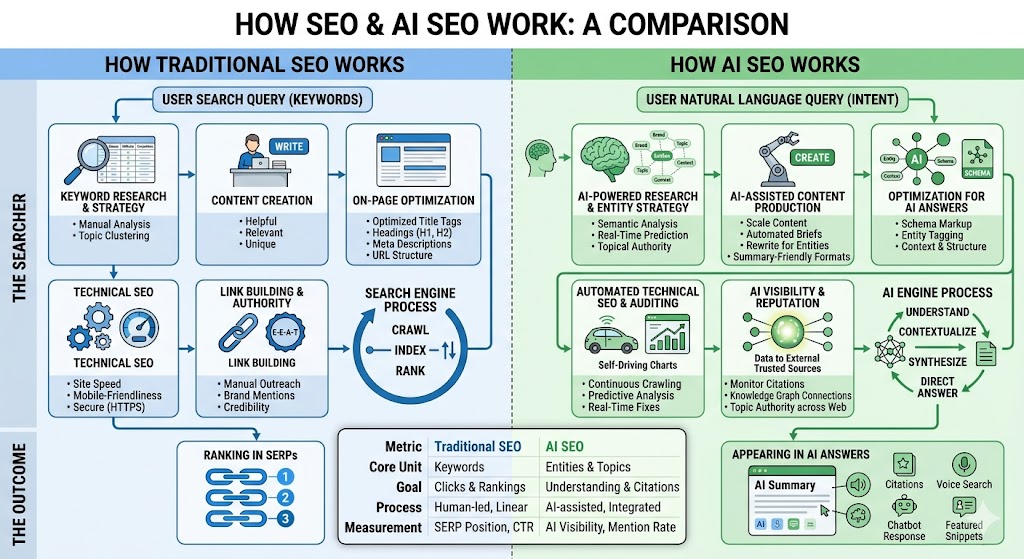
The fundamental architecture of digital information discovery is undergoing a structural transformation that represents the most significant disruption to marketing since the advent of mobile-first indexing. For more than two decades, Search Engine Optimization (SEO) has functioned as a highly predictable, linear mechanism: web crawlers indexed pages based on keyword density, technical infrastructure, and inbound link equity, subsequently returning sequential lists of blue hyperlinks to the end user. However, the rapid integration of Large Language Models (LLMs) and generative interfaces—including ChatGPT, Perplexity, Google's AI Overviews, Gemini, and Anthropic's Claude—has circumvented this traditional algorithm entirely. Modern search behavior is characterized by users receiving synthesized, zero-click narrative answers where AI models autonomously extract, summarize, and cite information directly, often eliminating the need for the user to visit the underlying website.
This behavioral shift has catalyzed a massive reallocation of enterprise marketing capital and software development. The market for AI-focused SEO and visibility tooling has expanded rapidly from a baseline of $1.2 billion and is currently tracking toward a projected valuation of $4.5 billion by the year 2033. The underlying business case driving this capital influx is compelling and mathematically quantifiable. Deep analytics indicate that visitors referred to a domain via an AI citation convert at a rate 23 times higher than traffic sourced from traditional organic search algorithms. Furthermore, targeted Generative Engine Optimization (GEO) campaigns are currently delivering an estimated return on investment (ROI) of $3.71 per single dollar allocated, with enterprise organizations frequently reporting gross yield increases of 300% to 500% within six to twelve months of active implementation. Concurrently, traditional organic click-through rates (CTR) have plummeted by as much as 61% to 68% for search queries that trigger AI Overviews or generative response blocks, forcing brands to adapt or face total digital obsolescence.
Despite these remarkable conversion metrics, the digital marketing industry currently operates within a transitional paradox regarding revenue attribution. Comprehensive survey data encompassing over 200 senior SEO practitioners reveals a stark disconnect between executive mandate and measurable financial impact. While 91% of executive leadership teams and boardrooms have explicitly demanded comprehensive AI search visibility strategies and dashboard reporting over the past twelve months, 62% of these same practitioners report that AI-driven search currently accounts for less than 5% of their total organizational revenue. This friction indicates that AI search visibility is reshaping corporate priorities and software procurement significantly faster than it is replacing baseline revenue streams. Consequently, digital marketing teams are being forced to adopt advanced, specialized tooling to measure leading indicators—such as brand citation frequency, share of voice within LLM outputs, and multi-model AI sentiment analysis—long before these metrics fully materialize into the lagging indicators of direct, attributable revenue.
Definitional Frameworks: The Taxonomy of the Generative Frontier
As the software ecosystem has evolved to service these emerging search modalities, the nomenclature surrounding the discipline has fractured, reflecting different philosophical approaches to machine readability. Approximately 36% of practitioners refer to the practice simply as "AI search optimization," while 27% maintain the traditional "SEO" label applied to new AI platforms. Another 18% utilize "Generative Engine Optimization" (GEO), while others prefer "Answer Engine Optimization" (AEO) or "LLM Optimization" (LLMO). Understanding the philosophical and technical distinctions between these frameworks is essential for properly evaluating the vast array of software tools currently deployed in the 2026 market.
The Foundation of Traditional SEO
Traditional Search Engine Optimization (SEO) remains the foundational infrastructure of digital visibility, even in the generative era. It focuses heavily on technical soundness, site architecture, content clustering, and domain authority. In the modern generative ecosystem, traditional SEO ensures that a brand's domain is present within the underlying indices that generative models scrape for training and retrieval. Without a robust traditional SEO presence, content is highly unlikely to be ingested by the training corpora or the real-time retrieval mechanisms of foundational LLMs. As industry consensus dictates, traditional SEO secures a brand's place in the master index, serving as the unavoidable prerequisite for any subsequent AI optimization efforts.
Answer Engine Optimization (AEO)
Answer Engine Optimization (AEO) represents the practice of structuring pre-indexed content so that it can be flawlessly extracted, summarized, and cited by AI-driven answer systems. If SEO ensures content is indexed, AEO ensures it is digestible by artificial intelligence. AEO operates on the premise that LLMs function as "answer engines" designed to resolve informational queries immediately and conclusively. Optimization tactics within this lane involve formatting content into highly scannable, hierarchical structures. Best practices necessitate the use of sequential heading tags (H1, H2, H3), short paragraphs, and bulleted facts that clarify entity relationships for web crawlers. AEO actively strips away subjective "marketing fluff," prioritizing authoritative claims and direct, structured evidence, because LLMs are mathematically programmed to favor rigid data points over generalized, persuasive rhetoric.
Generative Engine Optimization (GEO)
While frequently used interchangeably with AEO, Generative Engine Optimization (GEO) encompasses a broader and more aggressive technical philosophy. Proponents of the GEO framework argue that modern AI assistants are not merely passive "answer engines" but active, generative engines capable of complex tool utilization, function calling, planning, routing, and executing autonomous transactions. Therefore, GEO involves optimizing a brand's presence across the entire agentic workflow. This means ensuring that when an AI agent is tasked with booking a calendar slot, filling a digital shopping cart, or filing a compliance form, the brand's API, product catalog, or structured data is the specific entity selected and executed by the engine. In this context, success is defined not just by generating an optimized paragraph of text, but by convincing the engine to call the correct API arguments and execute a tangible result.
Ultimately, these three disciplines form a cohesive, sequential modern technology stack. SEO places the brand in the foundational index, AEO ensures the brand is accurately cited in informational summaries, and GEO embeds the brand deeply into the transactional behaviors of autonomous AI agents.
The Technical Mechanics of Machine Readability and Data Provenance
A critical and pervasive challenge facing the adoption of AEO and GEO tooling is the non-deterministic nature of Large Language Models. Traditional rank tracking software operates by scraping a highly deterministic Google Search Engine Results Page (SERP); if a domain ranks in the first position, it will generally remain there for all users in a specific geographic location at that moment in time. Conversely, generative engines construct novel, probabilistic answers dynamically every time a prompt is executed.
When evaluating tracking software, enterprise users frequently report severe discrepancies in data across different platforms. Tool A may issue one strategic recommendation, while Tool B suggests a contradictory action, even when both tools run the identical prompt against the identical LLM on the same day. This inconsistency stems from the fundamental architecture of Retrieval-Augmented Generation (RAG) and how different tools source their underlying data.
In a standard RAG workflow, an LLM first retrieves information from various web sources, synthesizes that information to form a coherent internal understanding of the topic, formulates a response, and finally selects which sources to append as visible citations. Different AI engines apply vastly different weighting mechanisms to this retrieval phase. For instance, ChatGPT historically applies heavy algorithmic weight to structured knowledge bases like Wikipedia, whereas Perplexity is heavily tuned to extract sentiment, consensus, and direct quotes from community forums such as Reddit.
Furthermore, a significant portion of legacy AEO tools rely on superficial citation counting—simply tallying how often a source URL appears at the bottom of an AI response. Advanced analytical research demonstrates that this methodology is fundamentally flawed. The sources appearing most frequently in an output's visible citations are not necessarily the mathematical sources that primarily shaped the model's internal understanding of the brand during the synthesis phase. Consequently, the most sophisticated platforms in the 2026 landscape have moved beyond basic citation tracking to measure deep "Topic Relevance" and "Brand Relevance." These advanced tools simulate millions of prompt variations to achieve statistical significance, tracking the influence of URLs on the model's latent space rather than relying on isolated, surface-level prompt tests.
The Enterprise AI Visibility Optimization Platform Tier
The highest echelon of the software market is currently dominated by specialized, enterprise-grade platforms engineered specifically to parse LLM behavior, manage complex data compliance standards, and operate at a massive, multi-national scale. These platforms are designed for Fortune 500 companies, heavily regulated industries, and global marketing teams. The primary platforms defining this tier are Profound, AthenaHQ, Evertune, and Conductor.
Profound: Deep Data Analytics and Compliance
Profound operates as a highly analytical, data-dense platform engineered for large enterprise organizations and regulated industries such as healthcare, pharmaceuticals, and finance. The platform achieves an industry-leading AEO technical score of 92/100, driven largely by its robust governance features, which include SOC 2 Type II and HIPAA compliance protocols.
Profound tracks brand visibility across an extensive array of AI interfaces, including ChatGPT (encompassing recent GPT-5.2 rollouts), Perplexity, Google AI Overviews, Microsoft Copilot, Claude, Gemini, DeepSeek, Meta AI, and Grok. Its primary technological differentiator is its immense data scale. The software features a proprietary "Conversation Explorer" fueled by a "Prompt Volumes" dataset built upon over 400 million anonymized real-world user conversations. This unique dataset allows enterprise strategists to analyze macro customer intent based on what humans actually type into chatbots, rather than relying on assumed keyword lists generated by traditional SEO tools. Furthermore, Profound utilizes "Query Fanouts," a feature that maps exactly how AI models transform basic human prompts into complex internal search parameters. Profound also offers dedicated "Shopping Analysis" modules to reveal how products are recommended in AI commerce conversations, and provides an "Agent Analytics" interface that integrates with Google Analytics 4 (GA4) to track exactly how AI bots crawl a website.
Financially, Profound operates on a rigid, credit-based pricing architecture that scales alongside computational consumption. Self-serve entry points begin at $499 per month for a "Starter" or "Lite" package, which includes a limited allocation of credits and restricts the team to a maximum of three seats. Custom enterprise configurations scale significantly higher based on organizational goals. While its analytical depth is largely unparalleled, the platform exhibits a steep learning curve. Its interface is heavily reliant on raw data visualization rather than automated execution, assuming that the enterprise has the internal analytical capacity to translate complex datasets into actionable content strategies. Reviewers frequently note that while Profound excels at research and visibility analytics, its generative content and outreach modules are less developed than its core tracking features.
AthenaHQ: Automated Workflow and Execution Velocity
Positioned as a direct ideological competitor to Profound, AthenaHQ prioritizes rapid execution, operational workflows, and automated content production over raw, siloed data analysis. Built for agile mid-market and enterprise teams, AthenaHQ identifies the primary friction point in AEO as the implementation gap—the delay between acquiring AI visibility data and actually updating the website's architecture and content.
AthenaHQ operates a proprietary "Query Volume Estimation Model" and tracks real-time trends across generative engines like ChatGPT, Gemini, Perplexity, DeepSeek, and Google's AI Overviews. However, rather than simply presenting a dashboard of citation metrics, its core offering is the highly integrated "Action Center". This operational module automatically generates AI-optimized content briefs, recommends structural architectural optimizations, generates brand guidelines, and initiates automated outreach to influential third-party sources that LLMs frequently cite. The platform connects directly to Content Management Systems (CMS) via one-click integrations, allowing content teams to immediately deploy AI-optimized material without leaving the software environment. Furthermore, AthenaHQ provides an unmatched expert network, granting users access to an elite group of AI specialists, advisors, and industry veterans for strategic consulting.
Financially, AthenaHQ utilizes a highly aggressive, flat-rate pricing strategy aimed at undercutting the credit-based models of legacy competitors. It offers a single subscription rate starting at $295 per month (with substantial introductory and annual discounts available), which includes all features, unlimited team seats, unlimited monthly response analysis, and full data history. This model avoids the strict feature-gating and per-seat licensing penalties common in the enterprise software space, making it highly attractive for teams that require high-velocity output rather than granular data interrogation.
Evertune: Statistical Significance and Direct LLM Integration
Evertune represents a highly capitalized, data-science-first entrant into the enterprise market, having secured $19 million in total funding, including a $15 million Series A round led by Felicis Ventures in late 2026, with angel backing from executives at OpenAI and Meta. The platform is engineered specifically to solve the data discrepancy and superficial citation problems inherent in early-generation AEO tools.
Evertune leverages direct API access to foundational LLMs alongside a massive proprietary dataset derived from the "EverPanel"—a continuous tracking panel of 25 million real internet users. This combination allows Evertune to bypass basic prompt simulation and instead observe how actual consumers interact with AI interfaces in the wild. The platform's breakthrough proprietary metrics, "Topic Relevance" and "Brand Relevance," mathematically dissect the RAG process to reveal which exact source URLs genuinely dictate an AI model's perception of a brand. It explicitly categorizes these sources into "Strength URLs" (highly influential sources that already mention the brand positively) and "Opportunity URLs" (highly influential sources that shape the category but do not yet mention the user's brand).
Furthermore, Evertune provides an aggregated "AI Brand Score," a proprietary index combining visibility frequency and ranking position to quantify a brand's overall prominence. The platform also features a "Content Studio" that utilizes word association maps to show the exact words AI models use to describe brands, sized by frequency and colored by sentiment, automatically generating messaging and blog copy to reframe AI narratives. Operating on a custom enterprise pricing model, Evertune is designed for sophisticated brands that demand statistical confidence and actionable strategy rather than simple reporting dashboards.
Legacy Enterprise Integrations: Conductor, BrightEdge, Yext, and Adobe
Organizations that manage complex, multi-national web properties often prefer to integrate AI visibility into their existing software infrastructure rather than procuring standalone AEO platforms.
Conductor, a legacy enterprise SEO behemoth, has adapted its sprawling platform to accommodate the AEO transition. It provides end-to-end coordination bridging traditional Google Search indexing with limited LLM visibility metrics. Conductor is highly suited for massive organizations that require strict cross-team workflows and need to manage traditional SEO alongside emerging GEO tactics within a single, unified interface. However, the platform remains extremely expensive, carries significant legacy technical debt, and offers a highly complex interface that lacks the specialized, nimble nature of AEO-native platforms.
Similarly, BrightEdge offers the "BrightEdge Prism" module, which achieves a mid-tier AEO score of 61/100. Its primary advantage is its legacy SEO integration, allowing enterprise teams to combine traditional technical workflows with generative visibility efforts seamlessly. Setup timelines are generally slower, averaging 6 to 8 weeks for full deployment.
Yext Scout bridges enterprise-grade search infrastructure with AI visibility, focusing heavily on localized data and entity management across distributed knowledge graphs, ensuring that local business data is accurately extracted by AI models. Adobe LLM Optimizer provides enterprise-scale AI search insights directly integrated into the broader Adobe Experience Cloud ecosystem, allowing massive brands to tie LLM visibility data directly to holistic customer journey analytics.
Enterprise Platform Capability Comparison
| Platform Name | Primary Value Proposition | Core Technological Differentiator | Target Audience | Pricing Architecture |
|---|---|---|---|---|
| Profound | Deep Data & Strict Compliance | 400M+ Prompt Volume Database | Fortune 500, Healthcare, Finance | Credit-Based (Starts $499/mo) |
| AthenaHQ | Workflow Automation & Velocity | Action Center & CMS Integration | Mid-Market, Agile Enterprise | Flat Rate ($295/mo, Unlimited Seats) |
| Evertune | Statistical Significance & Causality | 25M User "EverPanel" Data | High-Maturity Enterprise Brands | Custom Enterprise |
| Conductor | Unified SEO/AEO Coordination | Legacy Search Architecture | Massive Multi-National Orgs | Custom Enterprise (High) |
| BrightEdge Prism | Workflow Continuity | Legacy BrightEdge Integration | Existing BrightEdge Customers | Custom Enterprise |
Hybrid Solutions: Legacy SEO Suites Embracing the AI Era
Recognizing that pure-play AEO tools can cause severe software fragmentation for marketing teams, the dominant legacy SEO software providers have aggressively integrated AI visibility tracking and generative content creation into their existing monolithic suites. These platforms are optimal for organizations looking to bridge the gap between traditional keyword metrics and generative citations.
Semrush AI Visibility Toolkit
Semrush has deployed a comprehensive AI Visibility Toolkit as an add-on to its core platform. By analyzing a massive proprietary repository of queries, Semrush synthesizes complex AI citation data into a single, unified "AI Visibility Score". This metric functions as a high-level key performance indicator (KPI) for executive dashboards, simplifying multi-platform data into an accessible format. Semrush excels at tracking conversational follow-up queries, analyzing how a brand's visibility fluctuates as a user refines their prompt (e.g., transitioning from a broad query like "best CRM" to a specific query like "best CRM for manufacturing"). Furthermore, the platform offers a Share-of-Voice metric utilizing a highly accurate pixel-based calculation. Access to these features typically requires a Semrush One subscription, with plans starting around $165 per month. Semrush also offers a dedicated AI PR Toolkit with a 7-day trial for digital PR teams aiming to earn coverage from outlets that influence AI engines.
Ahrefs Brand Radar
Ahrefs has introduced "Brand Radar," a feature integrated directly into its core subscription starting at $129 per month (or included with existing accounts). Leveraging Ahrefs' colossal proprietary web crawling index, the tool monitors billions of prompts to calculate an AI Share of Voice (SoV) and detect exact brand mentions. While highly effective at immediate, large-scale mention detection and cross-referencing AI citations with traditional backlink profiles across varied channels including Reddit and YouTube, the tool currently lacks the proactive, generative content optimization workflows and specific GEO recommendations found in AEO-native platforms.
Surfer SEO, MarketMuse, and Clearscope
Surfer SEO, historically dominant in correlational NLP (Natural Language Processing) scoring for traditional Google rankings, has expanded its parameters to encompass LLM readability. For approximately $182 per month (or an add-on of $95/month to base plans), users gain access to AI tracking across five generative platforms. This allows content creators to optimize individual articles for both traditional Google SERP rankings and generative answer engine extraction simultaneously, utilizing features like keyword clustering, prompt research, and AI content detection.
MarketMuse operates as an advanced strategic intelligence and topical authority tool. It offers a tiered pricing structure, beginning with a free tier allowing 10 queries per month, scaling up through "Optimize" and "Research" tiers to a "Strategy" tier that provides unlimited queries, tracks 10,000 topics, and includes site heatmap tools to identify deep content gaps that AI models might exploit.
Clearscope, priced from $189 per month, uses advanced content analysis to evaluate readability, keyword relevance, and structural formatting, ensuring content is not only optimized for traditional competitors but structured for LLM digestion through automated content briefs and direct Google Docs/WordPress integrations.
AI Content Optimization and Generation Suites
A robust sub-category exists of tools focused primarily on utilizing AI to draft content that adheres to strict AEO formatting requirements.
Writesonic (GEO): Approaches the market from a content generation origin, charging approximately $199 to $249 per month for a unified professional suite that writes AI-optimized content, conducts prompt research, runs sentiment analysis, and notably monitors ChatGPT Shopping visibility, which is highly valuable for e-commerce.
Alli AI: Provides automated, on-page technical SEO and AEO fixes at scale without requiring coding expertise. Pricing starts at $299 per month for 500 keywords across 5 sites, scaling to $599 for agencies, and custom pricing for enterprise deployments.
Entry-Level NLP Suites: Tools like NeuronWriter (approx. $19–$23/month), Jasper ($39–$49/seat), Frase ($14.99–$114.99/month), and WriterZen (from $23/month) provide budget-friendly semantic structure analysis, brand-trained long-form content generation, SERP scraping, and large-scale keyword clustering to ensure baseline content is logically structured for AI ingestion.
Mid-Market, Agency, and Specialized Monitoring Software
Beneath the heavy enterprise tier exists a highly competitive ecosystem of specialized monitoring software tailored for small-to-medium businesses (SMBs), rapidly scaling startups, and marketing agencies. These tools prioritize fast onboarding, intuitive user interfaces, and highly specific niche functionalities over massive data lakes.
Tools Optimized for B2B Scaleups and Tracking Competitors
Omnia is explicitly designed for growth teams and B2B SaaS scaleups that require action-oriented data. It excels in tracking competitor displacement patterns—specifically identifying instances where a prospective buyer queries an AI for a software comparison (e.g., "Salesforce vs HubSpot" or "does [tool] integrate with Slack"), and the AI recommends a competitor over the user's brand. Omnia provides daily multi-engine visibility tracking, reverse-engineers the citations driving those answers, and offers proactive recommendations on URL formatting. Pricing starts at €79 per month for Growth, scaling to €499 for Enterprise.
Agency-Centric AEO Platforms
Peec AI serves as a dedicated solution for marketing agencies and collaborative environments. Recognizing that agencies must manage multiple global client portfolios simultaneously, Peec AI provides unlimited seats and robust workspace management. Its primary technical differentiator is an advanced sentiment analysis engine that continuously scans seven different AI platforms, immediately flagging negative or inaccurate brand descriptions output by generative models, and identifying the specific third-party sources influencing that visibility. Peec AI offers highly transparent pricing, starting at €89 per month (approximately $95) for 25 prompts, scaling to €199 per month for 100 prompts.
Nightwatch is another platform heavily favored by agencies, particularly those managing local SEO and AEO simultaneously. It provides precise geo-level tracking down to the ZIP code and city level for AI Overviews and chatbot tracking, offering a unified dashboard for traditional rank tracking alongside AI visibility. Add-on pricing for AI features starts at $99 per month for 100 prompts.
SE Visible (powered by SE Ranking) offers a strategic view of brand appearance across major systems, inheriting deep data accuracy from its parent company. For $189 per month, agencies gain multi-platform tracking, competitor benchmarking, sentiment analysis, and source analysis to determine which domains influence AI answers, making it ideal for CMOs and agency owners.
Specialized Technical Auditing and Bot Tracking
Scrunch AI, operating at a $250 to $300 per month entry point, provides a unique forensic capability: a real-time bot crawling feed. This tool tracks the exact timestamps when AI data crawlers (such as GPTBot, Anthropic's Claude bot, or PerplexityBot) access a specific domain. By correlating this backend server data with front-end visibility metrics and integrating with GA4, technical SEO teams can precisely monitor how crawler access impacts LLM citation rates. Scrunch AI also holds SOC 2 certification, appealing to compliance-focused organizations.
Otterly AI operates as a highly accessible, budget-friendly auditing tool starting at $29 per month for 15 tracked prompts, with standard plans at $189 per month. Instead of focusing purely on prompt tracking, it prioritizes technical infrastructure, running comprehensive GEO audits that evaluate over 25 technical factors. These include schema markup integrity, missing entities, and multilingual configurations, serving as a practical early warning system for technical deterioration that might prevent AI citations.
All-in-One Visibility and Action Platforms
AIClicks functions as an end-to-end AEO visibility and content delivery platform covering six major LLMs. It runs comprehensive AI visibility audits, mapping where brands and competitors appear, and utilizes built-in "AI agents" to automatically draft and publish content to fill identified citation gaps. Pricing is highly competitive, starting at a promotional $39 per month for 20 prompts and 10 AI blog posts, scaling up to $499 per month for enterprise capabilities.
Dageno AI operates as a balanced, user-centric platform that seamlessly blends traditional SEO data with generative search intelligence. Its proprietary "GEO Brand Influence Insights" metric evaluates brand authority by simulating real, complex user queries rather than executing static, generic prompt tests. It is frequently highlighted by industry reviewers for its transparent pricing and its ability to consolidate SEO and AI tracking into a single interface, significantly mitigating software sprawl for mid-market teams.
Conversely, Geneo positions itself as a comprehensive GEO platform offering real-time multi-platform monitoring, sentiment analysis, and deep historical AI search query tracking across customizable workspaces. However, industry analysis indicates that Geneo currently exhibits a steep learning curve and lacks the extensive public user review ecosystem seen with platforms like Dageno AI. This suggests that Geneo caters predominantly to private, complex enterprise deployments rather than fast-moving SMBs.
Forensic Testing and High-Volume Rank Checking
Eldil AI is distinctly positioned as an AEO-native "testing lab" rather than a broad optimization suite. Designed strictly for forensic analysis, it allows data scientists and technical SEOs to run structured A/B tests across models. Marketing teams can deploy structured schema or brand messaging updates and use Eldil AI to observe clear before-and-after behavioral shifts in how assistants like Gemini or Claude interpret the updated entities at the citation level. Eldil operates exclusively on an enterprise pricing model.
For teams focused strictly on raw rank tracking and citation counting without the need for generative workflows, several highly specialized tools exist:
- Rank Prompt: Integrates tightly with CRM ecosystems (notably HubSpot, which offers a $50/mo AEO tool) to connect top-of-funnel AI citations directly to closed-won revenue, utilizing a credit-based system ranging from $39.17 to $119.17 per month.
- Rankscale: A budget-friendly option at $20 per month offering granular manual control over schema audits and basic AI rank tracking.
- AEO Vision: Priced at $299 per month for Growth plans, this tool uniquely integrates alternative AI discovery platforms, notably offering Reddit Insights and beta access to TikTok Trend Analysis alongside standard tracking for 5 AI platforms.
- Ziptie AI: Charges $69 per month for 500 checks, uniquely capturing actual visual screenshots of how a brand appears in AI responses to provide undeniable evidence of visibility.
- AI Rank Checker: Utilizes a highly flexible pay-per-check model ranging from $0.03 to $0.18 per keyword check, ideal for sporadic auditing.
- LLMRankings IO & LLMRefs: Offer entry-level continuous weekly monitoring, with LLMRankings starting as low as $10 per month and LLMRefs offering keyword-focused (rather than prompt-focused) tracking across 10+ engines for $79 per month.
- Mangools AI: Provides highly accessible entry-level AI search visibility across six major engines starting at just $12 per month, making it the most affordable entry point for solo practitioners.
- Advanced WEB Ranking: Designed for massive-scale rank and AI tracking, starting at $139 per month.
- Promptwatch: Focuses heavily on ROI attribution, uniquely tracking how forum discussions and Reddit rankings influence subsequent AI recommendations.
- SERP Gap Analyzer: Priced at $79 per month, this tool clusters topics and identifies low-difficulty, high-potential keyword gaps in traditional and generative SERPs.
- Gumshoe AI: Focuses on a proprietary "Share of LLM" metric, simulating real buyer personas to test what specific customer segments are likely to ask, offering a flexible pay-as-you-go model.
Comparative Feature Set of Specialized Monitoring Tools
| Tool Name | Ideal Use Case | Key Technical Capability | Starting Price |
|---|---|---|---|
| Omnia | B2B SaaS / Scaleups | Competitor Displacement Tracking | €79 / mo |
| Peec AI | Marketing Agencies | Multi-Brand Workspaces & Sentiment | €89 / mo |
| Scrunch AI | Technical SEO / Enterprise | Real-Time Bot Crawl Monitoring | $250 - $300 / mo |
| Otterly AI | Technical Auditing | 25+ Factor GEO Audits | $29 / mo |
| AIClicks | Content Automation | Built-In AI Drafting Agents | $39 - $59 / mo |
| Dageno AI | Mid-Market Brands | GEO Brand Influence Simulation | Custom / Tiered |
| AEO Vision | Trend-Focused Brands | Reddit & TikTok Trend Integration | $299 / mo |
| Rank Prompt | ROI Attribution | CRM (HubSpot) Integration | $39.17 / mo |
The E-Commerce Imperative and the Rise of Agentic Commerce
The intersection of retail e-commerce and generative artificial intelligence represents the most lucrative and rapidly evolving sub-sector of the search market. Top-tier management consulting firms project that billions of dollars in gross merchandise value will be routed exclusively through AI-driven conversational searches by the year 2027. Generative engines are increasingly bypassing traditional e-commerce aggregators and standard Google Shopping feeds. Instead, they synthesize authentic customer sentiment, aggregate product reviews from across the web, and analyze technical specifications to confidently recommend specific products directly to the consumer in a narrative format.
This landscape is rapidly advancing toward "Agentic Commerce," a paradigm in which AI agents not only research and recommend products but possess the autonomous API capabilities to execute transactions, add items to carts, and complete checkouts natively within the chat interface, completely removing the brand's traditional website from the user journey.
Goodie AI: The Agentic Commerce Suite
Goodie AI is currently the preeminent software platform designed specifically to address this transactional shift. Operating as an advanced "Agentic Commerce Suite," Goodie AI maps exactly how AI models perceive complex product catalogs. The platform tracks product visibility within highly transactional and rapidly growing environments, including ChatGPT Shopping and Amazon Rufus.
Priced at an enterprise level starting at $399 per month, Goodie AI monitors how autonomous AI crawlers interact with merchant feeds. It isolates visibility gaps based on specific product attributes (e.g., "most durable running shoe under $100") and generates highly specific, prioritized optimization actions that align a brand's technical infrastructure with machine-readable commerce protocols. Furthermore, it provides Analytics & Attribution modules designed to prove ROI by connecting AI product visibility directly to top-line retail revenue.
Specialized E-Commerce AEO Agencies
Because e-commerce optimization requires incredibly deep technical modifications to platform architecture (e.g., Shopify, Magento, BigCommerce) and mastery of dynamic inventory feeds, many brands outsource execution to specialized agencies rather than relying solely on software.
Market evaluations highlight AEO Engine, Victorious, and Searchbloom as the premier technical partners in this sector. AEO Engine, notably, reports an average 920% lift in AI-driven traffic for its retail clients across various e-commerce verticals, establishing the benchmark for the category. These specialized agencies differentiate themselves from traditional SEO firms by moving beyond generalized content production. Instead, they focus relentlessly on granular product schema markup implementation, dynamic merchant feed API integration, and the optimization of technical entities to ensure autonomous shopping agents can frictionlessly extract real-time product pricing, inventory status, and variation data.
Architecting the Automation Layer: APIs and Workflow Execution
As Answer Engine Optimization transitions from a theoretical novelty to a daily operational requirement, the ability to automate tracking and execution workflows has become paramount. Manual tracking of non-deterministic LLM outputs across thousands of queries is mathematically and logistically impossible at an enterprise scale. Consequently, modern AEO platforms rely heavily on Application Programming Interfaces (APIs) and third-party automation software to execute strategies.
High-quality API documentation is essential for integrating AEO data into existing marketing stacks, reducing friction for developers, and driving enterprise adoption. Platforms such as Zapier and n8n serve as the crucial connective tissue between disparate marketing technologies. Without requiring advanced programming capabilities, technical marketers utilize these visual, drag-and-drop builders to construct highly complex, automated optimization loops. While Zapier is faster to set up with extensive native integrations, n8n offers self-hosting and no execution limits, making it ideal for high-volume enterprise AEO operations.
A standard automated AEO workflow in the 2026 landscape operates as follows:
- Detection: An AEO monitoring tool (e.g., Omnia, AEO Vision, or Evertune) detects a statistically significant drop in citation frequency for a core product category.
- Trigger: The platform fires a real-time webhook to an n8n or Zapier sequence.
- Analysis: The automation layer calls the OpenAI (GPT-4) or Anthropic (Claude) API, commanding the LLM to analyze the specific competitor content that recently displaced the brand in the AI's internal ranking.
- Execution: The system automatically generates a structured content brief designed to reclaim the narrative, extracts required JSON-LD Schema markup from a CMS database, validates the schema against Schema.org standards via the Google Search Console API, and routes the comprehensive brief to a human copywriter via Slack or project management software.
Furthermore, robust API architecture allows digital data teams to export raw AEO metrics into centralized data warehouses like Snowflake or Google BigQuery. From there, the data is piped into advanced visualization tools such as Looker Studio, Tableau, or Power BI. This enables data scientists to build blended dashboards that juxtapose traditional Google Search Console click metrics alongside generative citation rates, share of voice analytics, and CRM conversions. Organizations deploying these automated pipelines consistently report 60% to 80% time savings on repetitive technical tasks, allowing senior SEO strategists to focus entirely on high-level narrative shaping and strategic positioning.
Strategic Deductions and Future Market Trajectories
A comprehensive synthesis of the 2026 AEO and AI SEO software landscape reveals several underlying trends, causal relationships, and future trajectories that will dictate the next phase of digital marketing economics.
1. The Inevitable Consolidation of Workflow and Analytics
The current software market is heavily bifurcated into deep analytical tools (e.g., Profound, Evertune) and rapid execution tools (e.g., AthenaHQ, Writesonic, AIClicks). As the market matures, these two distinct capabilities must inevitably merge. Deep analytics without automated execution leads to organizational paralysis, as teams cannot update content fast enough to impact the data. Conversely, automated execution without statistically significant data leads to the rapid proliferation of misaligned, hallucinated content that fails to move the needle. Venture capital flows suggest that the future market leaders will be platforms that successfully combine massive, direct API access to foundational models (for data integrity) with autonomous, agentic workflow execution (for velocity).
2. The Extinction of Superficial Citation Counting
The underlying mechanics of Retrieval-Augmented Generation are rapidly rendering basic citation tracking obsolete. Because an LLM can parse fifty underlying sources during its synthesis phase but only visibly cite three in its final output, tracking software that only monitors the final output link fails to capture the true architecture of brand influence. The industry is aggressively pivoting toward conceptual tracking parameters—such as Evertune's "Topic Relevance" and "Brand Relevance." Consequently, SEO professionals will increasingly focus their PR efforts on placing structured brand mentions within highly authoritative secondary sources (e.g., Reddit, specialized industry forums, Wikipedia, tier-one publications) rather than attempting to manipulate their own direct domain properties. LLMs rely heavily on this third-party consensus to validate claims, making off-page digital PR more critical than ever.
3. The Resolution of the Attribution Paradox
The current systemic disconnect between the high perceived strategic value of AI search and its low quantifiable revenue impact is unsustainable for enterprise budgets. The fundamental problem is that zero-click answers destroy traditional UTM (Urchin Tracking Module) and cookie-based attribution pipelines. If there is no click, legacy analytics platforms record no value. Tools like Rank Prompt, Goodie AI, and platforms integrating heavily with GA4 and CRMs are pioneering the solution. The next iteration of AEO software will utilize advanced probabilistic modeling and server-side tracking to mathematically correlate macro shifts in AI Share of Voice with offline pipeline velocity and CRM closed-won data. This will finally allow Chief Marketing Officers to accurately calculate the financial ROI of generative optimization, unlocking massive enterprise budgets currently held in reserve.
4. The Structural Reorganization of Enterprise Marketing Teams
The technical complexity of ensuring machine readability via JSON-LD structured data, combined with the editorial nuance required to shape an LLM's brand sentiment, is forcing a radical reorganization of digital marketing teams. Traditional, siloed SEO departments are evolving into cross-functional "AI Search Operations" units. These modern units combine technical SEO engineers (responsible for managing schema validation and server log crawler access), digital PR specialists (managing third-party narrative consensus), and prompt engineers (analyzing LLM behavior and fanouts). Software platforms that offer unlimited seats, flexible workspaces, and robust collaborative environments—such as Peec AI, Geneo, and AthenaHQ—are uniquely positioned to facilitate and capture value from this organizational shift.
The optimization of artificial intelligence engines has transitioned permanently from an experimental, edge-case tactic to foundational corporate infrastructure. The array of tools, platforms, and methodologies evaluated in this report represent the vanguard of a multi-billion dollar paradigm shift in how human commerce, information discovery, and brand perception are navigated in a post-search engine era. Organizations that fail to rapidly deploy sophisticated architectural monitoring and generative alignment strategies risk total, irreversible invisibility in the exact digital channels where modern consumer decisions are now finalized.